NEP 2020 ICT Requirements for Classrooms: What's Mandated
NEP 2020 does not fix a number of smart boards, computers or internet speed for classrooms. It asks schools to integrate technology into teaching, give teachers suitable equipment and close the digital divide. The numbers principals hear quoted come from other documents: Samagra Shiksha norms and CBSE affiliation bye-laws.
This guide separates the three, so you know what is policy intent, what is a funding norm, and what an inspector can actually ask for. It covers classrooms only. Skill labs and robotics labs are a separate subject with their own rules.
In one line: NEP 2020 tells you why and what for. Samagra Shiksha tells government and aided schools how much. CBSE bye-laws tell affiliated schools the minimum. None of them tells a private school which panel to buy.
What NEP 2020 actually says about classroom technology
The Union Cabinet approved the National Education Policy on 29 July 2020. Technology sits mainly in two chapters: Chapter 23, Technology Use and Integration, and Chapter 24, Online and Digital Education. The government's official note on the policy sums up the intent in one sentence: technology will be integrated into all levels of education "to improve classroom processes" (PIB note on NEP 2020).
The paragraph-wise action points published on the government's MyGov portal show what that means for a school:
Purposes of technology (para 23.5): improving teaching, learning and evaluation, supporting teacher preparation and professional development, widening access, and streamlining school planning and administration.
Equipment for teachers (para 23.6): suitable equipment is to be made available to teachers at schools so they can integrate e-content into their teaching.
Platforms (para 23.6): better integration of platforms such as DIKSHA across school education.
A national forum (para 23.3): the National Educational Technology Forum (NETF), an autonomous body, to advise on the induction, deployment and use of technology.
Digital education (para 24.4): a list of initiatives that includes digital infrastructure, online teaching platforms and tools, a digital content repository, training and incentives for teachers, online assessment, blended models of learning and laying down standards.
A dedicated unit (para 24.5): to build digital infrastructure, digital content and capacity.
What NEP 2020 does not say
This is the part most sales presentations skip. In the official highlights and the paragraph-wise action points we checked for this article, there is no figure for any of the following:
The number of smart classrooms a school must have
The size or type of display in a classroom
The number of devices per student
A minimum internet speed
A date by which every classroom must be digital
NEP 2020 is a policy document. It sets direction and leaves numbers to schemes, boards and states. So if a proposal says "NEP 2020 makes interactive panels compulsory in every classroom", ask for the paragraph number. A claim like that should be checked against the policy text before it is used to justify a purchase.
The honest reading is: the direction is fixed, the hardware is your decision.
Where the real numbers come from
Samagra Shiksha: ICT and Digital Initiatives (government and aided schools)
This is the central scheme that funds classroom technology, and the Ministry of Education has told Parliament that it is aligned with NEP 2020. Its published norms are:
Coverage: government and aided schools with Classes VI to XII
Smart classrooms: non-recurring grant of Rs 2.40 lakh for 2 smart classrooms per school
Smart classrooms, recurring: Rs 0.38 lakh, covering e-content, digital resources and electricity charges
ICT lab: non-recurring grant of up to Rs 6.40 lakh per school, with a recurring grant of up to Rs 2.40 lakh a year for 5 years
Choice: a school that has not had ICT support before can opt for either an ICT lab or smart classrooms; a school that already has ICT support can add smart classrooms
Scale: the scheme page reports 1,20,614 ICT labs and 82,120 smart classrooms sanctioned to states and union territories so far (the page carries no date for this total)
Two points matter for principals. First, these are funding ceilings for government and aided schools, not a specification for private schools. Second, they are still a useful benchmark: the government's own norm treats two smart classrooms as the starting unit for a school, not one room for show. If your school buys through the government route, our GeM smart classroom purchase guide explains the process.
CBSE affiliation bye-laws (affiliated schools)
The infrastructure norms on the CBSE website contain the only hard ICT numbers that apply to private CBSE schools, and they sit under the computer laboratory clause, not the classroom:
Computers: a minimum of 20, with a computer-to-student ratio of 1:20 (clause 4.4.1)
Internet: connectivity "with good speed", with no figure given (clause 4.4.2)
Scale: one computer lab for up to 800 students, and one more for every additional 800 (clause 4.4.3)
Classroom displays: the page has no clause requiring projectors, panels or smart boards in classrooms
So an affiliation inspection can check your computer count and connectivity. It does not, on these norms, check whether each classroom has an interactive panel.
State boards and state schemes
States run their own smart-classroom programmes and sometimes issue their own orders. If your school is state-board or aided, check the latest order from your state education department. We have not tried to summarise 28 states here, because those orders change often.
How far Indian schools have actually got
The Ministry's UDISE+ 2024-25 report, released in August 2025, gives the national picture:
Schools with computer access: 64.7%, up from 57.2% a year earlier
Schools with internet: 63.5%, up from 53.9%
Schools with electricity: 93.6%
Roughly one school in three still has no computer or no internet. That is the digital divide Chapter 24 of the policy is concerned with, and it is why the policy speaks of equity before it speaks of equipment. For a private school the practical lesson is different: a display on the wall achieves little if the network behind it is weak. Our guide to school WiFi and network design covers that part.
A practical classroom ICT baseline (our recommendation, not a mandate)
Since the policy leaves the hardware to you, here is the baseline we suggest to schools that want to be able to show NEP-aligned classroom practice. Treat it as advice from an integrator, not as a rule from any authority.
In every classroom you equip
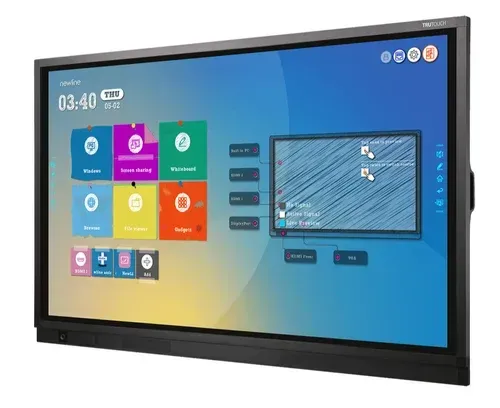
One shared display that the whole room can read from the last bench. See our notes on smart classroom design for sizing and placement.
A teacher device, or a display with a built-in computer, so that e-content can be opened without borrowing a laptop
Reliable power and a wired or strong wireless connection at the teacher's wall
Audio that reaches the back row
Across the school
Access to curriculum-aligned content, starting with free government platforms such as DIKSHA
A training plan for teachers, because the policy names teacher development as a purpose of technology in its own right
A named person who looks after the equipment and logs faults
On paper
A phased plan: which classrooms this year, which next, and why
A simple usage record, so you can show that the equipment is used in lessons and not just installed
Budgets vary widely with the number of rooms and the type of display. Our smart classroom setup cost breakdown gives indicative ranges component by component.
Classrooms are not labs
NEP 2020 also drives the push for skill education and hands-on labs, and CBSE has separate requirements for those. They are a different purchase with a different purpose. If you are planning one, Grobots covers it in detail on its Composite Skills Lab page. For how multidisciplinary learning spaces fit the policy, see our earlier post on NEP 2020 multidisciplinary labs.
Frequently Asked Questions
Does NEP 2020 make smart classrooms mandatory?
No clause we could find in the government's official highlights or paragraph-wise action points makes smart classrooms compulsory or sets a number per school. NEP 2020 asks for technology to be integrated into teaching and for teachers to have suitable equipment. Specific numbers come from schemes such as Samagra Shiksha, which fund two smart classrooms per government or aided school.
How many computers must a CBSE school have?
The infrastructure norms on the CBSE website ask for a minimum of 20 computers and a computer-to-student ratio of 1:20, with one computer lab for up to 800 students and another for every additional 800. The same norms ask for internet connectivity with good speed, without stating a figure. They do not specify displays for classrooms.
Is there government funding for smart classrooms in private schools?
The ICT and Digital Initiatives component of Samagra Shiksha covers government and aided schools with Classes VI to XII. Its norm is Rs 2.40 lakh for two smart classrooms per school, plus a recurring grant of Rs 0.38 lakh. Private unaided schools are not covered by these norms and fund classroom technology from their own budgets.
What is NETF in NEP 2020?
NETF is the National Educational Technology Forum, an autonomous body proposed in paragraph 23.3 of the policy. Its role is to provide a platform for exchanging ideas on the use of technology in learning, assessment, planning and administration, and to help governments and institutions decide what technology to induct and deploy. It advises. It does not issue purchase mandates to schools.
Does NEP 2020 specify interactive flat panels or projectors?
No. The policy speaks of technology, digital infrastructure and suitable equipment, and does not name a product category. Whether a classroom uses an interactive flat panel, a projector or another display is the school's decision. Choose on the basis of room size, daylight, how teachers will use it and what it costs to maintain over its life.
What should a school show to demonstrate NEP-aligned ICT use?
Evidence of use counts for more than a list of equipment. Keep a phased plan for equipping classrooms, a record of teacher training, examples of lessons that use digital content such as DIKSHA resources, and a simple log of how often classroom displays are used. These show integration into teaching, which is what the policy asks for.
Planning classroom technology for your school?
AVM Infotech helps schools plan classroom technology in phases, starting from how teachers will use it. If you want a second opinion on a proposal, or a room-by-room plan, talk to us.
Call +91 99814 44724 | Visit avminfo.in
By Anand Ingle, AVM Infotech. Scheme norms and statistics are quoted from the Ministry of Education's Samagra Shiksha page, the UDISE+ 2024-25 release and the CBSE website as read in November 2026. Check the current documents before you rely on them.

