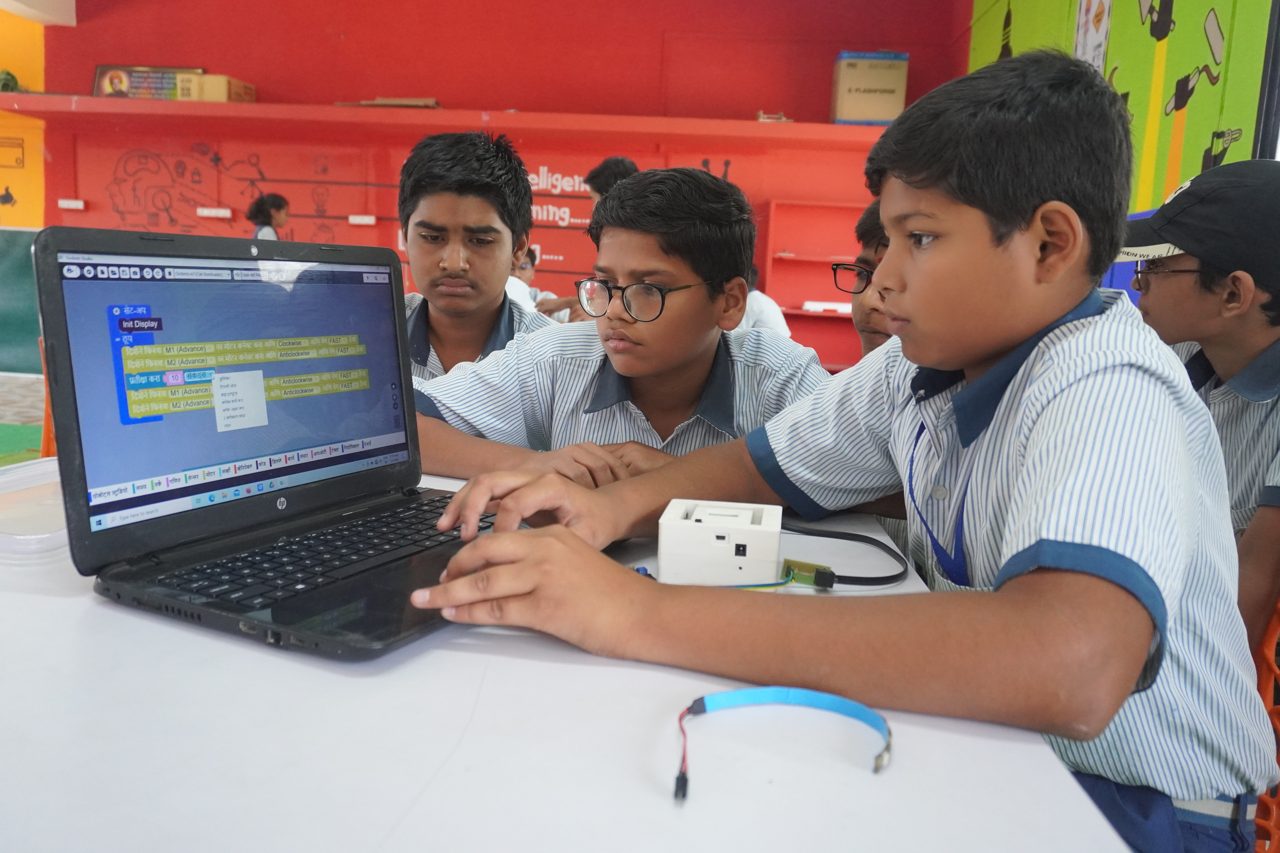
Language Lab for Schools: Cost, Setup and CBSE Fit
A language lab for schools is software that lets every student speak, record, hear themselves back and get pronunciation feedback at the same time, something a normal English period cannot do for forty children in forty minutes. In 2026 it is a license and a set of headsets far more often than it is a dedicated room, and it can run on a computer lab you already own or on a single interactive panel.
Before anything else, one thing worth saying plainly: no CBSE circular or affiliation requirement names a language lab. It is not a compliance item. If a vendor tells you it is, ask for the circular number. A language lab is an elective investment you make because spoken-English outcomes matter to your parents, and it should be judged on that alone.
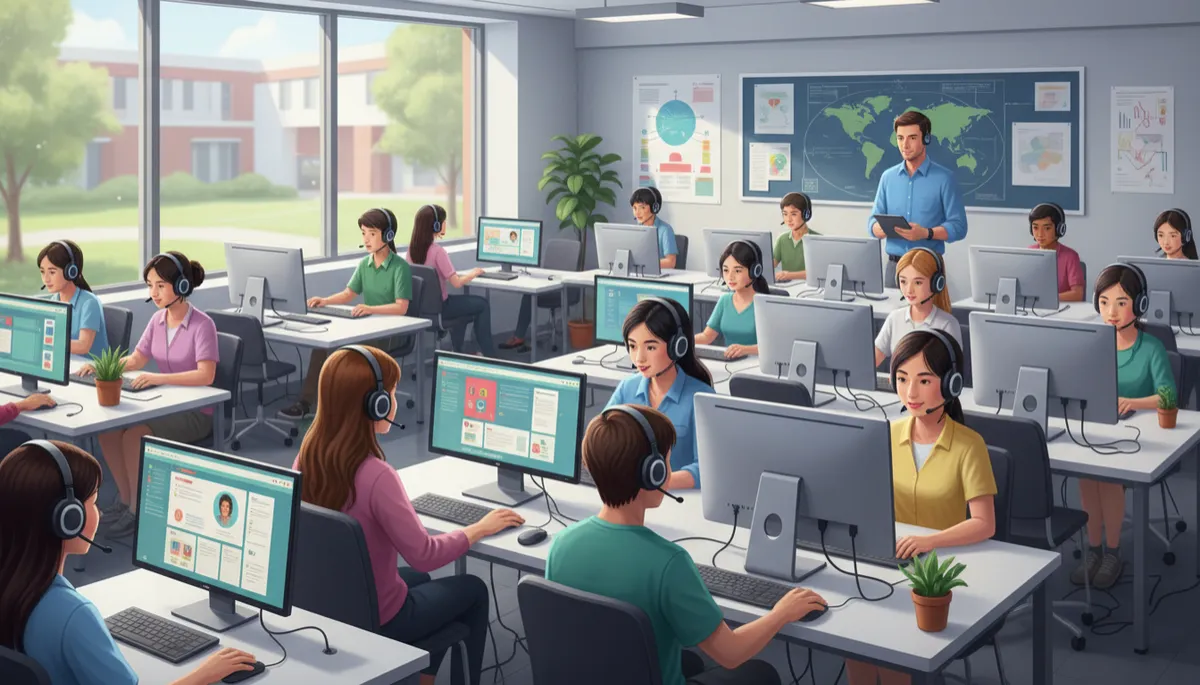
What a language lab actually does
The old model was a room of booths with tape decks. The current model is software with a teacher console and the capability set is fairly consistent across serious vendors.
Listen, record, compare: the student hears a model speaker, records their own attempt and plays both back side by side. This one loop is the reason language labs exist.
Speech recognition scoring: automated feedback on pronunciation accuracy, clarity and pace, so a child gets a response in seconds rather than waiting for the teacher to reach their desk.
Teacher console: the teacher can listen in on any student, break the class into pairs or groups for conversation practice, and intervene privately without stopping the room.
Structured content: graded exercises for listening, speaking, reading and writing, usually mapped to school year levels.
Progress tracking: per-student records over a term, which is what turns a lab period into evidence you can show a parent.
The most valuable feature is the least glamorous: every child speaks for the whole period. In a conventional oral lesson, a class of forty gives each student roughly thirty seconds of speaking time; in a lab period, each speaks for most of forty minutes. That multiplier is the entire business case, and any evaluation that does not test it is measuring the wrong thing.
The three setup models
How you deploy matters more than which brand you pick, because deployment decides your cost and your timetable capacity.
Model 1: Computer lab based
Runs on: your existing computer lab, one seat per student
Extra hardware: headset with microphone per seat, plus a teacher console machine
Best for: schools that already have 20–30 working machines and spare lab periods
Watch for: your computer lab is probably already booked for IT and AI practicals
Model 2: Panel or classroom based
Runs on: an interactive flat panel in a normal classroom, whole-class mode
Extra hardware: panel plus audio; optional headsets for paired practice
Best for: schools that want language practice in the regular classroom rather than a booked room
Trade-off: you lose simultaneous individual recording unless you add devices, this is the model's real limitation and vendors rarely lead with it
Model 3: Cloud or browser based
Runs on: any browser, including student devices at home
Extra hardware: headsets; reliable bandwidth becomes the dependency
Best for: schools that want practice to continue outside the lab period
Watch for: per-user annual licensing, which scales with enrolment rather than with seats
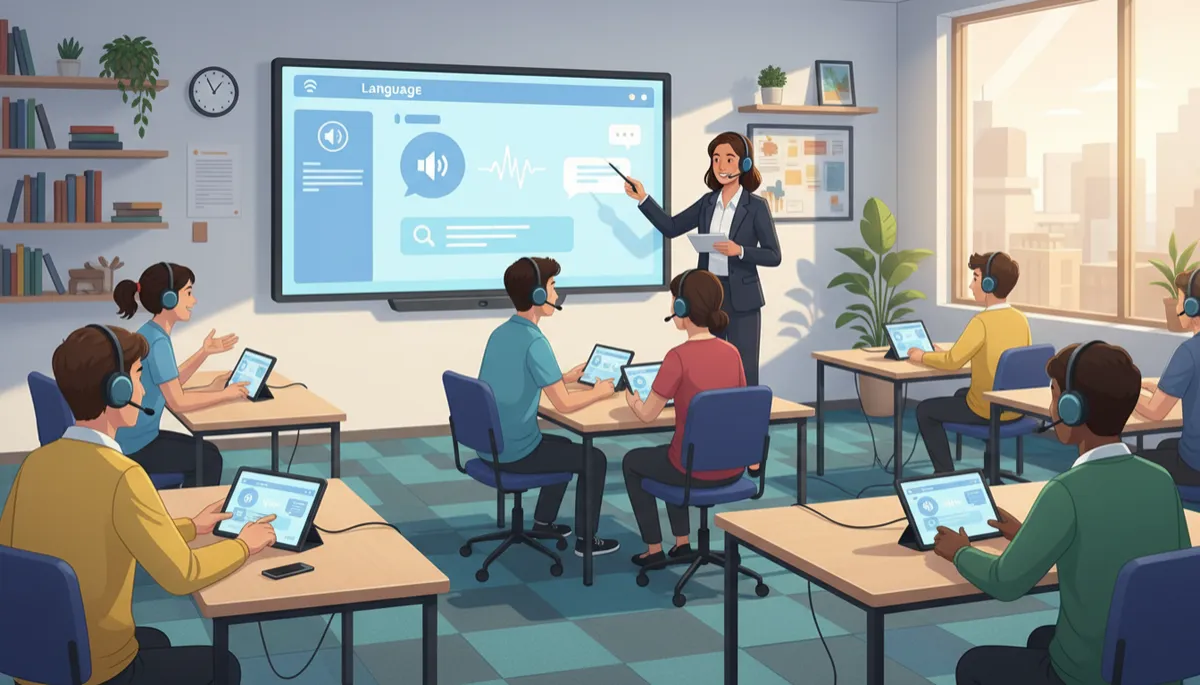
What a language lab costs in India
Honest caveat first: language lab pricing is quoted, not listed, and the numbers publicly visible are all over the place. Published 2026 listings from Indian suppliers for school language lab software run from roughly ₹11,000 to ₹45,000 depending on license scope and seat count.* Treat that as a range for the software line only, not a project budget, and get written quotes for your seat count.
The lines your budget actually has
Software license: the headline number confirm whether it is perpetual or annual and how many concurrent seats it covers
Headsets with microphone: one per seat, plus spares; this is the most commonly under-budgeted line and the first thing to fail in a school
Computers: zero if you are reusing a lab, significant if you are not
Interactive panel, if you go the classroom route: from around ₹90,000 plus GST for a 65-inch panel, with typical school configurations landing at ₹1.2–1.5 lakh
Power backup: a UPS at around ₹5,500 keeps a session from dying mid-recording
Annual renewal and AMC: recurring, and the line that quietly decides whether the lab is alive in year three
*Figures marked with an asterisk are indicative bands drawn from publicly visible 2026 supplier listings and vary by configuration, seat count and license term. Panel and UPS figures reflect current pricing on the configurations we supply. Ask for a written quote before you budget.
If you are building this alongside other classroom technology, our smart classroom setup cost breakdown and the smart classroom equipment checklist cover the shared infrastructure power, network, audio that a language lab depends on and rarely gets costed into.
Why language labs go unused and how to prevent it
This is the part vendors skip. A meaningful share of school language labs are quiet within two years and the causes are documented, repetitive and preventable at purchase time.
Batch size
A lab sized for 40 or 60 students defeats itself the teacher cannot attend to that many speaking learners at once. Twenty to twenty-five is the practical ceiling for a single teacher. Size the room for the batch you can actually teach, then split the class, rather than buying seats you will never use well.
Timetable starvation
One lab period a week does not build spoken fluency. Language practice is a frequency exercise, not a volume one. Two shorter sessions beat one long one, and a lab that is only available when the computer lab is free will lose every scheduling conflict it enters.
The supervision reflex
The teacher console has a listen-in feature, and the temptation is to use it constantly. Students who know they are being monitored every minute speak less, not more, which inverts the point of the room. The console is for targeted coaching, not surveillance.
The learning curve
Teachers presented with the full feature set at once tend to retreat from it. Train on the single core loop first model, record, compare, feedback and leave group conversation modes, assignment distribution and analytics for a second session a month later.
Personnel change
Most labs die when the one teacher who understood the system leaves. Insist that at least two teachers are trained, and that the vendor's training is recorded and rewatchable rather than delivered once on installation day.
What to write into the purchase order
License term stated explicitly: perpetual or annual, seat count, and the renewal price fixed for at least three years
Headsets included and quantified, with a replacement rate, do not let these become an afterthought purchase in month two
Training for a minimum of two teachers, with at least one refresh session in the following term
A recorded demo on your own hardware before payment, using your actual machines and your actual bandwidth
Named support contact and response time, not a generic helpdesk address
Content alignment to your syllabus and languages, confirmed by an English teacher from your school, not by the sales team
NEP 2020 is explicit that technology "will be extensively used for language teaching and learning", which is a mandate for outcomes, not a mandate for a particular room. A school that gets every child speaking daily on a panel and a set of headsets has satisfied the intent better than one with a beautiful unused lab.
Frequently asked questions
Is a language lab mandatory for CBSE schools?
No. There is no CBSE circular or affiliation requirement that specifies a language lab, and it does not appear on any mandatory infrastructure list the way a science lab or a composite skill lab does. Schools install language labs to improve spoken-English outcomes and support the three-language formula under NEP 2020, which is a pedagogical decision rather than a compliance one.
How much does a language lab cost for a school in India?
Software licenses in publicly visible 2026 listings range from roughly eleven thousand to forty-five thousand rupees depending on seat count and license term, and that is only one line of the budget. Add headsets for every seat, computers if you are not reusing an existing lab, power backup, and annual renewal or AMC. Total project cost depends far more on whether you already have hardware than on which software you choose.
Can we run a language lab without a dedicated computer lab?
Yes, using an interactive flat panel in a regular classroom with whole-class listening and speaking activities. The trade-off is real and worth understanding before you buy: without individual devices, students cannot all record themselves at the same time, which removes the listen-back loop that makes a language lab more effective than a good oral lesson. Many schools run the panel model first and add headsets and devices later.
How many students should a language lab session have?
Twenty to twenty-five is the practical maximum for one teacher. Beyond that the teacher cannot listen to, coach and respond to every speaking student within the period, which is precisely the capability being paid for. Schools with larger sections generally split the class and run two shorter sessions rather than seating forty students at once.
Which languages can a language lab support?
Most school-focused platforms in India lead with English and support regional Indian languages and Hindi, with some offering foreign languages such as French and German. Language coverage varies significantly between vendors, so confirm the specific languages your school teaches are supported with full content, not just interface translation, before signing.
How often should students use the language lab?
Twice a week in shorter sessions works better than one long weekly period. Spoken fluency responds to frequency rather than duration, and a single weekly slot is also the first thing sacrificed when the timetable comes under pressure. Fix the slots in the timetable at the start of the year, before other subjects claim the room.
What is the difference between a language lab and a smart classroom?
A smart classroom is general-purpose teaching infrastructure a display, audio and connectivity used across every subject. A language lab is purpose-built software for listening and speaking practice, with individual recording and a teacher console. The two overlap in hardware: many schools run language lab software on smart classroom equipment they already own rather than building a separate room.
Talk to us about your setup
The right first question is usually what you already own and what your timetable can absorb. We will look at your existing hardware and tell you honestly whether a language lab is the right next purchase, or whether something else should come first.
Call us on +91 99814 44724 or visit avminfo.in to arrange a demo on your own equipment. For background on the wider classroom picture, see our guides to smart classrooms and 21st-century learning. Schools also planning a CBSE Composite Skill Lab can read more on composite skills labs.
Policy reference: National Education Policy 2020.

