Smart Classroom Equipment: Essential 2026 Checklist
The essential smart classroom equipment for an Indian school in 2026 is: an interactive flat panel, a classroom audio system, a visualiser (document camera), reliable Wi-Fi and a UPS, and a source device (built-in Android or a connected PC/laptop). Everything else — PTZ cameras, digital podiums, VR kits — is a useful add-on, not a starting requirement.
A basic working setup starts around ₹95,000 per classroom; a premium, AI-enabled room runs ₹2.5–4 lakh. This checklist explains what each piece does, what actually matters when you buy, and where schools waste money.
The core smart classroom equipment (buy these first)
These five items turn an ordinary room into a functioning smart classroom. Get them right before adding anything else.
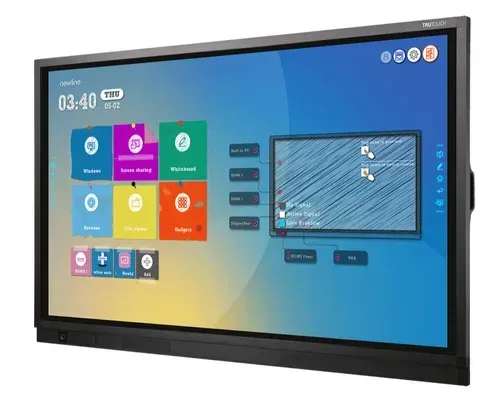
Interactive Flat Panel (IFP). The centrepiece — a 4K multi-touch display (20-point touch), built-in Android/Windows, and anti-glare toughened glass. Sizes: 65", 75" and 86". This replaces the projector-plus-whiteboard combo entirely.
Classroom audio system. The most under-bought item. Even a great panel fails if the back row can't hear. A wireless teacher mic plus distributed speakers fixes it.
Visualiser / document camera. Puts a textbook page, a worksheet or a science specimen on screen instantly — bridges physical and digital teaching.
Networking (Wi-Fi 6) + UPS. In Indian conditions a dedicated 1–2 kVA UPS is non-negotiable to protect the panel from voltage swings. Stable Wi-Fi makes content, updates and cloud tools usable.
Source device. Most IFPs have built-in Android; add an OPS PC or laptop dock if teachers need Windows software.
Smart classroom equipment checklist & indicative price
Indicative 2026 per-classroom ranges for planning. Actual pricing depends on brand, size and quantity.
Essential — start here
Interactive Flat Panel (65"–86"): ₹95k–1.8L — display + touch teaching
Classroom audio (mic + speakers): ₹8k–25k — clear sound to every seat
Visualiser / document camera: ₹6k–20k — show physical material
UPS (1–2 kVA): ₹6k–15k — power protection
Wi-Fi 6 / networking: ₹5k–20k — connectivity (often shared across rooms)
Recommended
OPS PC / laptop: ₹35k–60k — for Windows apps
Optional add-ons
PTZ camera: ₹25k–65k — hybrid / recorded classes
Digital podium: ₹40k–90k — teacher control station
VR / AR kit: ₹50k–2L — immersive lessons
Rule of thumb: spend on the panel and the audio together. An 86" display with no sound system loses the back three rows — a common and avoidable mistake.
What actually matters when you buy an IFP
Spec sheets bury the things that decide whether teachers use the panel daily:
Brightness & anti-glare — 400+ nits and a matte finish keep it readable in sunlit rooms.
Touch points & latency — 20-point touch with low latency for natural writing.
Android version & RAM — enough to run modern teaching apps without lag.
Warranty & on-site support — a 3-year on-site warranty matters more than one extra feature.
For the full picture on how these fit together, read our guide to what a smart classroom is and its types and uses.
Where schools waste money
Skipping audio. Buying an 86" panel then losing the back three rows because there's no sound system.
No UPS. One voltage spike can cost more than the UPS would have.
Over-buying VR on day one. Immersive kits are great — after teachers are comfortable with the basics.
No teacher training. The single biggest reason panels end up used only as a projector.
Smart classrooms and hands-on labs solve different problems. If you're also planning a practical skills or robotics room, see how a composite skill lab is equipped — the buying logic is similar but the kit is different.
FAQ
What equipment is needed for a smart classroom?
At minimum: an interactive flat panel, a classroom audio system, a visualiser, stable Wi-Fi and a UPS, plus a source device. Optional add-ons include PTZ cameras, a digital podium and VR/AR kits.
How much does smart classroom equipment cost in India?
A basic setup starts around ₹,000 per classroom. A mid-range room is roughly ₹1.2–2 lakh, and a premium AI-enabled classroom runs ₹2.5–4 lakh, mainly depending on panel size and audio.
Is an interactive flat panel better than a projector?
For most classrooms, yes — IFPs are brighter, touch-enabled, need no bulb replacement and combine display, whiteboard and computer in one device. Projectors still suit very large halls or the tightest budgets.
What size interactive flat panel should a school buy?
65" suits small rooms, 75" is the common classroom standard, and 86" fits larger rooms or the back rows sitting far from the board. Match size to room depth and seating.
Do smart classrooms need a UPS?
Yes. Indian power fluctuations can damage panels and source devices. A dedicated 1–2 kVA UPS per room is essential protection, not an optional extra.
Planning smart classrooms for your school?
AVM Infotech has equipped 500+ institutions since 2005. Get a site-specific quote with the right panel size, audio and support plan for your rooms.

