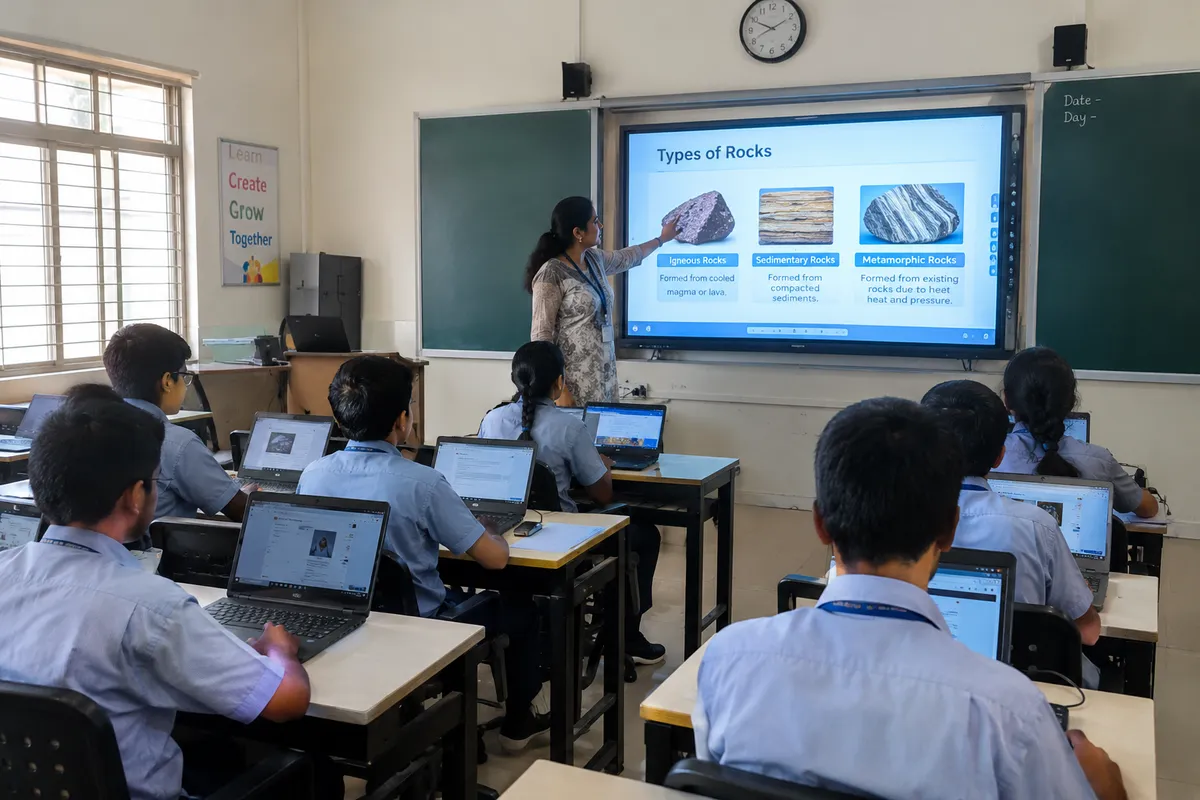
Classroom Speaker System for Schools: What to Buy
For most Indian classrooms, the right classroom speaker system is a pair of wall or ceiling-mounted speakers with a small mixer-amplifier and a wireless microphone for the teacher, not just the speakers built into the display. Public listings put complete classroom PA sets in the tens of thousands of rupees, so sound is one of the cheapest upgrades you can make to a smart classroom.
Schools routinely spend lakhs on interactive panels and then leave the back benches straining to hear. This guide explains why audio gets underfunded, what to buy for a 40-seat classroom, and how to compare quotations without being sold the wrong thing.
Why schools underspend on classroom audio
Audio is invisible in a demo. A 75-inch panel impresses a management committee in seconds; a speaker does not. Budgets get consumed by the display, and sound becomes "whatever comes in the box". Three things make this a mistake.
First, noise. The ANSI/ASA S12.60 classroom acoustics standard, summarised by Armstrong World Industries, sets a maximum background noise of 35 dBA in an unoccupied, furnished classroom and a reverberation time of 0.6 seconds for rooms under 10,000 cubic feet. Many Indian classrooms with open corridors, ceiling fans, hard floors and roadside windows are well above this before a single student speaks. A US study of 58 elementary classrooms found every one exceeded the 35 dBA limit, and that background noise explained about 30 percent of the variation in reading comprehension scores (Consulting-Specifying Engineer, 2011). That is a correlational study from one district, so treat it as a signal, not a promise for your school.
Second, the teacher's voice. A teacher speaking over fans and corridor noise for six periods a day strains the voice. Amplification is widely promoted to reduce that strain, but researchers have also cautioned that it is not a cure-all: in a 2007 Education Week report, the Acoustical Society of America advised fixing the room first with acoustic treatment, and noted that amplification mostly helps teacher-to-student communication, not student-to-student discussion.
Third, content. Videos, language lessons and listening exercises are played from the display. If the audio path is weak, the interactive lesson loses its value.
The four speaker options for a classroom
1. Built-in speakers in the interactive panel
Good for a small room, a coaching class or a breakout space. Check the rated wattage in the spec sheet rather than assuming; our guide to reading an IFP spec sheet covers what to look for. Built-in speakers face forward from the panel and are often inadequate for a full 40-seat room with fans running.
2. Soundbar below or above the panel
A step up for medium rooms. Easy to install and tidy, but it keeps all the sound at the front. Students at the back and near the windows still hear least.
3. Wall-mounted or ceiling speakers with a mixer-amplifier
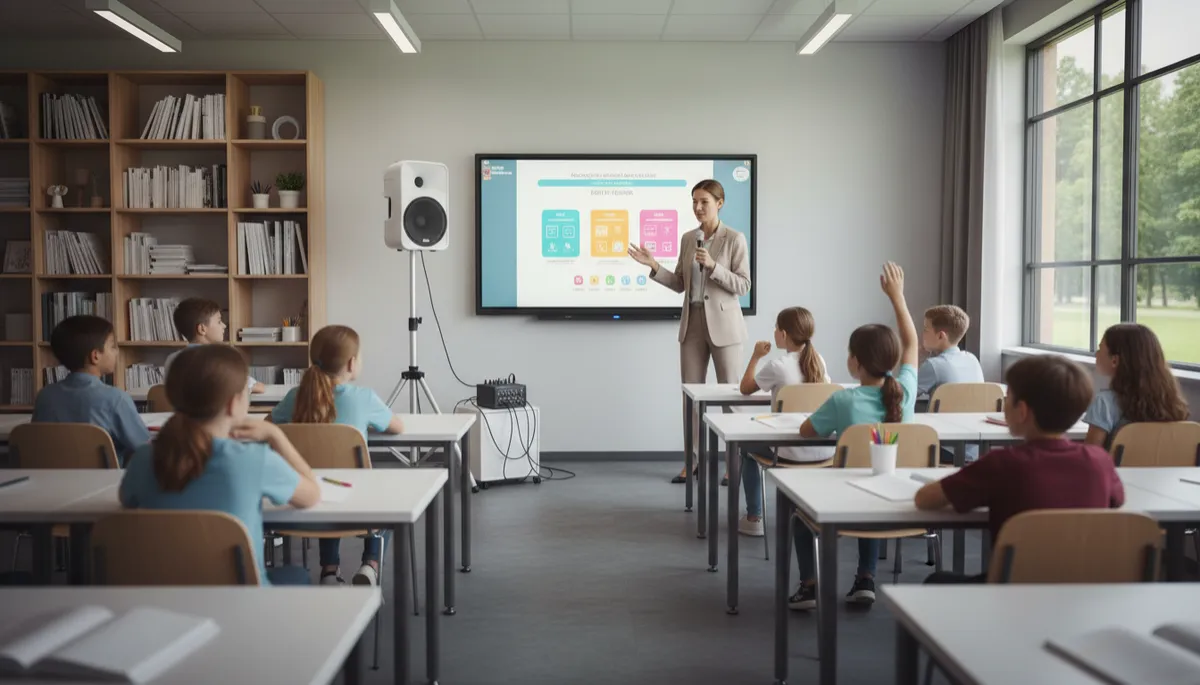
The standard answer for most schools. Two speakers placed to cover the room evenly give more consistent volume front to back, so the teacher does not need to shout and the volume does not have to be so loud at the front. This is the setup most vendors mean by a "classroom PA set".
4. Teacher voice amplification (lapel or headset microphone with room speakers)
Adds a wireless microphone so the teacher's voice reaches the back clearly without effort. Valuable for large classes, noisy sites and teachers with long teaching loads. It is usually combined with option 3.
Indicative price bands from public listings
These are not quotations. They are what we found on public marketplaces in October 2026 and they vary widely by brand, wattage and installation. Use them only to sense-check what a vendor quotes you.
Classroom PA set (GeM listing): an Ahuja PA system for halls and classrooms is listed at ₹47,000 (MRP ₹60,000). It includes two wall-mount speakers, a mixer amplifier, an MP3/USB digital player and wireless microphones. Power draw is 90 W in operation. The listing offers free installation only in selected NCR cities.
School broadcast and bell systems (IndiaMART listings): listed prices range from about ₹3,000 for a basic 100 W unit to about ₹35,000 for a system with an intercom, with most between ₹12,000 and ₹30,000. These are for whole-school announcements and bells, not a replacement for in-classroom teaching audio.
Active classroom speakers: some trade listings show 40 W RMS two-way active speakers made for classrooms, but without a public price. Ask for a written quote.
The takeaway: audio for one classroom costs a small fraction of the display, and a whole-school bell system is a different product from classroom teaching audio. Do not let one quotation stand in for the other.
How to choose: a 7-point checklist
Room size and seating. Measure length, width and ceiling height, and count the seats. Ask the vendor how many speakers cover the room evenly.
Background noise. Note fans, open windows, corridors and AC. Louder rooms need better placement, not just more watts.
Hard surfaces. Bare walls, tile floors and glass increase echo. A few acoustic panels or curtains often help more than a more expensive amplifier.
Input sources. The panel, laptop, microphone and any visualiser should all connect without adapters hanging from the wall.
Microphone type. Choose a wireless lapel or headset microphone if the teacher moves around, with spare batteries or a charging dock.
Cabling and mounting. Ask for concealed cabling, a lockable amplifier location and safe speaker mounting.
Warranty and service. Get the warranty period and the service response time in writing.
Common mistakes to avoid
Buying by watts alone. A louder amplifier in a bad room just makes louder echo. Speaker placement and room treatment matter as much as power.
Treating the school bell system as classroom audio. A broadcast unit is designed for announcements. It will not give a teacher a microphone path or panel connection.
Skipping the microphone. Without one the speakers only help when playing media. The teacher still projects over the noise.
Ignoring the room. Standards bodies and researchers both say to treat acoustics first. If the classroom echoes badly, plan some soft surfaces alongside the equipment.
Where audio fits in your smart classroom budget
When you plan a smart classroom, put audio in the first draft of the budget next to the display, the mounting and the network. Our smart classroom setup cost breakdown shows how each component fits together, and the smart classroom equipment checklist lists the items to confirm before you sign off. For layout and viewing distances, see smart classroom design.
If your school is also planning a robotics or STEM lab, the same acoustic thinking applies in labs, where tools and motors add noise; the lab specialists at Grobots cover that side.
Frequently asked questions
Do I need a separate speaker system if my interactive panel has built-in speakers?
For small rooms, built-in speakers can be enough. For a typical 40-seat classroom with fans and corridor noise, separate wall or ceiling speakers give more even coverage, so back-bench students hear clearly. Check the wattage in the panel's spec sheet, then decide after testing the panel at full class size with the fans on.
How many speakers does a classroom need?
Two wall-mounted speakers cover most standard classrooms evenly. Very wide or long rooms may need a second pair, and small rooms may need only a soundbar. Ask the vendor to show the intended placement and coverage for your room dimensions instead of quoting a standard number.
What is the price of a classroom speaker system in India?
Public listings in October 2026 show a complete classroom PA set, with two wall speakers, an amplifier and wireless microphones, at about ₹47,000 on GeM, while school broadcast units range from roughly ₹3,000 to ₹35,000. Real prices depend on brand, wattage and installation, so always get a written quotation.
Is a school bell and broadcast system the same as a classroom audio system?
No. A broadcast and bell system sends announcements and bells to many rooms. A classroom audio system is built for teaching: it connects the panel and laptop, adds a teacher microphone and places speakers to cover the room. Many schools need both, and they are bought and installed separately.
Does classroom noise really affect learning?
Research suggests it can. A study of 58 US elementary classrooms found a negative correlation between background noise and reading comprehension scores. The study is correlational and from a single district, so it does not prove cause, but it supports treating classroom acoustics as part of any smart classroom plan.
Get classroom audio right the first time
Tell us your room sizes, the display you plan to use and your budget, and we will propose a speaker and microphone set that fits, with a written quotation and service terms. Call or message AVM Infotech and we will arrange a site visit.
Request a QuoteCall or WhatsApp Us
By Anand Ingle. Price points come from public GeM and IndiaMART listings checked in October 2026 and are indicative only; they are not AVM Infotech quotations.

