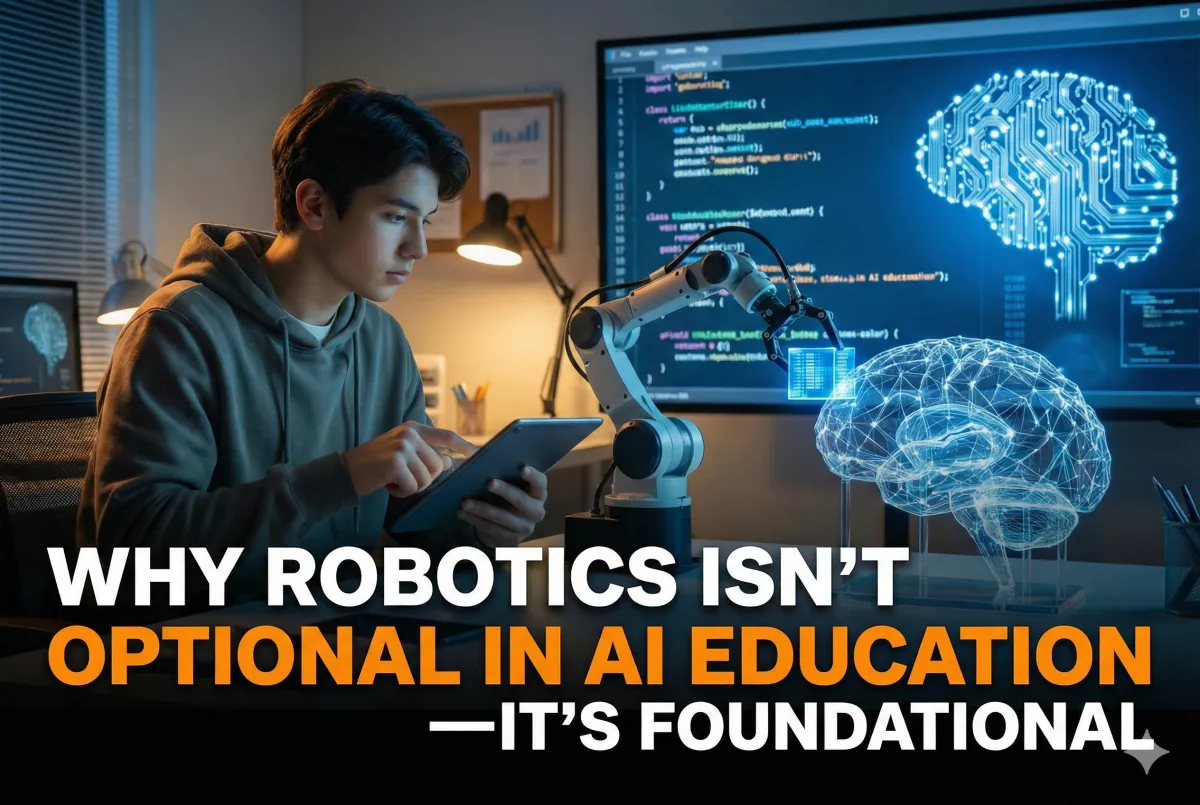
Why Robotics Isn't Optional in AI Education—It's Foundational
Artificial intelligence may seem like magic, but without robotics, it remains incomplete. At AVM Infotech India Pvt. Ltd., one of India's leading edtech solutions providers, we believe that robotics is not just a complement to AI, it is the foundation upon which genuine intelligence is built. Just as children learn by touching, observing, and acting, intelligent machines must interact with the real world to truly "learn."
Robotics Makes Intelligence Tangible
Robotics transforms abstract AI algorithms into something physical and observable. When a robot senses its environment and acts upon it, intelligence becomes tangible. This connection between sensing and doing helps students and innovators understand how machines perceive, decide, and respond; moving beyond theory to real-world application.
Where traditional AI deals with data and computation, robotics introduces the critical elements of sensing and action. It's this feedback loop; perception, decision, and movement that creates the foundation for meaningful learning in both machines and humans. Without robotics, we risk reducing intelligence to mere pattern recognition rather than fostering true understanding.
The Science Behind the Synergy
AI focuses on learning and decision-making, while robotics provides the sensing and action layer that fuels that learning. Together, they create a complete cycle:
Sensors gather information from the environment
AI models interpret this information to make decisions
Actuators execute actions, allowing the system to learn from results
In education, this synergy helps students bridge physics, mathematics, and computer science—delivering a truly interdisciplinary experience. When students program a robot to navigate obstacles, they're simultaneously grasping feedback loops, data interpretation, and optimization, the same concepts driving modern AI systems.
Why Physical Computing Must Come First
Before intelligence can emerge, there must be interaction. Physical computing teaches students to build digital systems that sense and respond—hands-on learning that aligns seamlessly with the CBSE curriculum's emphasis on interactive problem-solving to strengthen cognitive and analytical skills.
Starting with robotics helps learners visualize how intelligence evolves: from basic inputs and outputs to complex predictive and adaptive systems. It creates a clear pathway for understanding how AI learns from real-world feedback, much like the human brain adapts through sensory experiences.
The Cost of Separating Robotics from AI
Treating robotics as secondary or optional limits meaningful learning. Without physical interactions, AI education becomes abstract and disconnected from reality. The outcome? Students who can code algorithms but don't understand how those decisions manifest in motion, sound, or vision. To teach intelligence effectively, students must see and shape it through interaction.
The Bottom Line: You Can't Teach Intelligence Without Interaction
At AVM Infotech India Pvt. Ltd., we enable schools and institutions to integrate AI and robotics education through hands-on STEM labs and interactive learning platforms. Intelligence isn't learned in isolation; it's discovered through doing, experimenting, and interacting with the world around us.
Ready to transform your institution's approach to future-ready learning? Explore innovative solutions at www.avminfo.in and empower your students to build a future where robotics and AI grow together.

