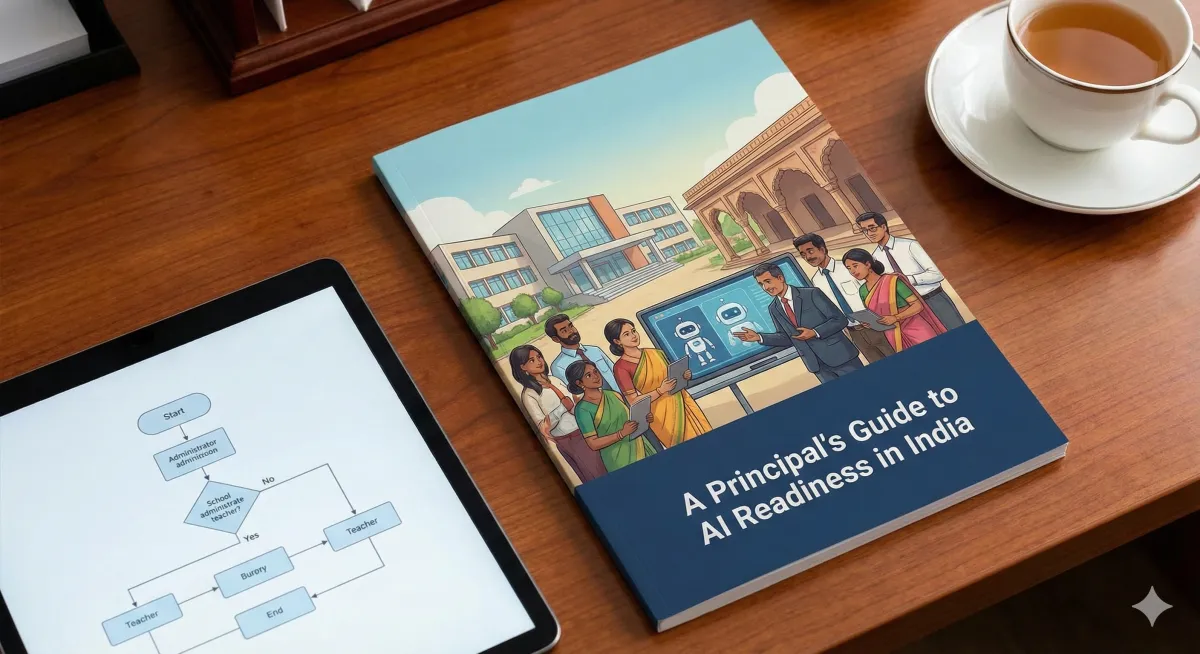
A Principal's Guide to AI Readiness: The Three Stages of Understanding
A Principal's Guide to AI Readiness: The Three Stages of Understanding
Introduction: Preparing Students for Their Future
When your current students graduate, Artificial Intelligence will be as common and influential as smartphones are today. It will quietly shape the world around them, influencing their futures in profound ways.
AI will be the invisible force behind their:
Decisions
Opportunities
Information
Systems
Navigating this requires an intentional, structured, and age-appropriate readiness journey. This new reality presents every school with a critical decision: Will students merely use intelligent systems, or will they be equipped to understand, question, and shape them responsibly?
The Common Misstep in AI Education
Most current "AI programs" make a critical error: they jump directly to impressive AI demonstrations and tools while skipping the foundational concepts. This approach creates a superficial and potentially dangerous understanding of the technology.
Students are impressed, but they don’t truly understand what is happening underneath. That is risky.
To build genuine competence and critical awareness, students need a more structured and intentional learning progression that builds understanding from the ground up.
The Intellectual Backbone of True AI Readiness
The intellectual backbone of a true AI readiness journey is a clear, gradual progression. To shape AI, students must first understand systems. This journey moves from the concrete and human-defined to the abstract and data-driven, ensuring no conceptual gaps are left behind.
The three core stages are: Computational Thinking → Rule-Based Automation → Learning-Based AI Systems
Let's break down what each of these essential stages truly means in a simple, accessible way.
Stage 1: Computational Thinking (Designing the Logic)
Computational Thinking is the foundation. In this stage, students learn to analyze problems and design solutions by thinking about systems in terms of inputs, decisions, and outputs.
Think of it like creating the recipe for a cake. Before you can bake, you must first write down the exact ingredients (inputs), the step-by-step instructions (rules/logic), and what the final cake should be (output). This is the essential foundation we build in Grades 3-4, where students use tools like block-based coding to make their thinking visible and learn the core principles of cause and effect.
Students design the logic themselves, establishing a clear and direct understanding of cause and effect.
Stage 2: Rule-Based Automation (Following the Logic)
Rule-Based Automation is a system that uses sensors and logic to perform repeatable actions based on rules that humans have explicitly programmed. This stage represents the core learning objective for Grades 5-6, where students take their understanding of logic and apply it to the physical world using sensors and motors.
Crucially, these systems follow human-defined rules exactly, with no capacity for learning, adapting, or guessing.
This is like a smart thermostat. It follows a simple, pre-programmed rule:
IF the temperature drops below 20°C,
THEN turn on the heater.
It never learns, adapts, or tries to predict if you're feeling chilly.
Systems follow rules exactly, demonstrating how human logic can be executed with perfect consistency by a machine.
This mastery of rule-based systems is not the end goal; it is the essential prerequisite for asking more sophisticated questions. Before introducing AI, students must first be able to articulate: When are explicit rules enough? When do we need a system that can learn from data? And what are the risks involved in making that choice?
Stage 3: Learning-Based AI (Adapting from Data)
Learning-Based AI is a fundamentally different kind of system. Instead of following explicit instructions, it learns from vast amounts of data to make predictions about new, unseen information. This critical transition happens in Grades 7-8, where students, now equipped with a strong systems mindset, are ready to compare rule-based logic with learning-based AI using tools like Python and Google Teachable Machine.
There are three critical characteristics of Learning-Based AI:
It learns from data: It is trained to identify patterns in information it's given, not programmed with explicit rules.
It makes predictions: Its output is a sophisticated guess based on probabilities, not a guaranteed certainty.
It can be uncertain or biased: Its performance depends entirely on the quality, quantity, and nature of the data it learned from. Flawed data leads to flawed predictions.
This is like a movie recommendation service. It doesn't have a simple rule like "Show more action movies." Instead, it learns from the viewing habits of millions of people to predict what you might want to watch next. Sometimes its predictions are great, and sometimes they're wrong. Unlike the simple IF/THEN logic of the thermostat, there is no single rule here. The system's 'logic' is a complex, ever-changing map of patterns learned from data.
Systems adapt, and must be supervised. This stage introduces students to the essential modern concepts of probability, bias, and accuracy.
The Critical Difference: A Choice in Design, Not Better Logic
It is vital to understand that the transition from a Rule-Based system to a Learning-Based AI is not about creating "better logic." It's about recognizing when a problem is better solved by human-defined logic versus when it's better solved by data-driven predictions. One is not inherently 'smarter' than the other; they are fundamentally different tools for different tasks.
AI is not better logic. It is a different design choice.
This table summarizes the core differences every student must understand to become a responsible designer of technology.

Conclusion: From Users to Responsible Designers
True AI readiness begins not with AI tools, but with teaching students how to think critically about systems. By guiding them through the foundational stages of Computational Thinking and Rule-Based Automation, we empower them to grasp the profound shift that Learning-Based AI represents, all within a structured framework designed for real-world school environments.
This three-stage progression is essential to preparing students to be more than just consumers of technology. The goal is to prepare students not just to use intelligent systems, but to understand, question, and shape them responsibly.

