Future-Proofing Student Careers: Robotics Education for India's Digital Economy
Future-Proofing Student Careers: Robotics Education for India's Digital Economy
India's digital economy is on track to reach $1 trillion by 2026, driven by Industry 4.0 sectors including advanced automation, electric vehicles, and semiconductor manufacturing. Schools that establish robotics labs today are making strategic investments in their students' future employability, transforming classrooms into training grounds for high-demand careers. AVM Infotech India Private Limited provides educators with advanced edtech solutions designed for effective robotics integration.
India's Manufacturing Transformation
India is positioning itself as a global manufacturing leader, targeting a $500 billion electric vehicle market by 2030 and developing a $100 billion semiconductor ecosystem. Government programs like Production Linked Incentive schemes and the India Semiconductor Mission are generating millions of jobs in automation and AI-driven manufacturing. According to World Economic Forum research, 85% of jobs in 2030 will require digital proficiency, giving students with robotics skills a significant competitive advantage.
Practical Learning with Measurable Outcomes
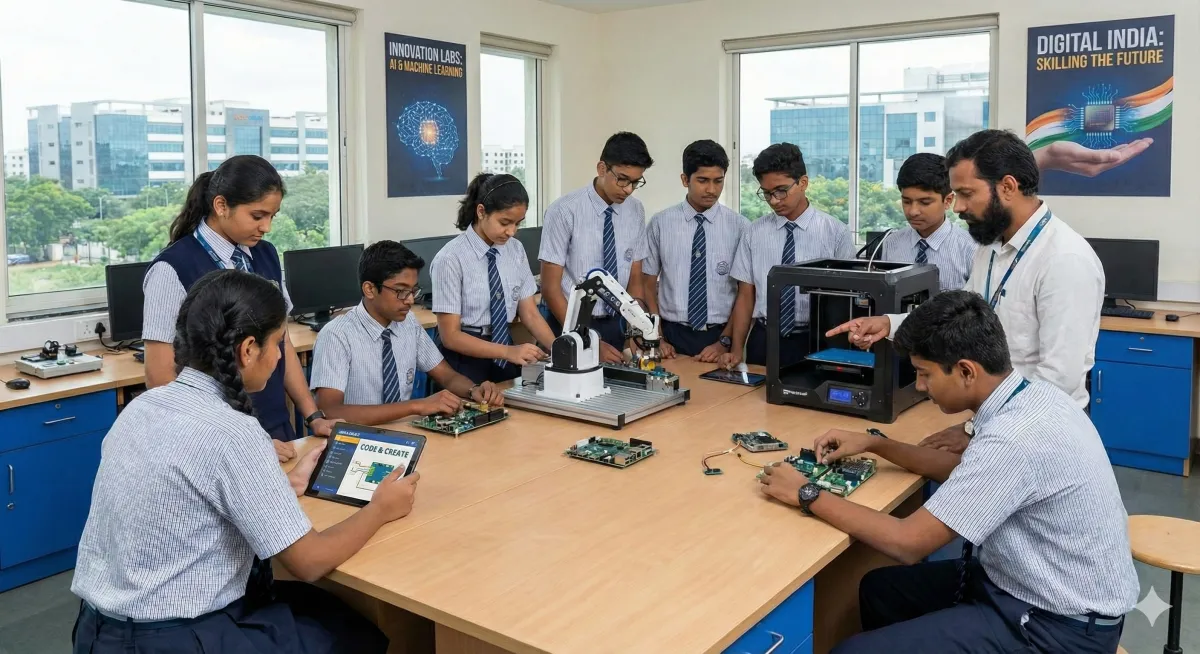
Composite Skill Labs provide students with hands-on experience using industry-standard technology such as Arduino boards, robotic arms, and programmable logic controller systems that mirror the equipment found in electric vehicle plants and semiconductor fabrication facilities. This approach connects classroom learning with industry requirements, with studies showing employability improvements of up to 40% through certifications in Robot Operating System and Industry 4.0 protocols. Unlike traditional memorization-based education, project-based robotics learning develops problem-solving capabilities that yield long-term career benefits. Alumni working at companies like Tata Motors or Foxconn often command starting salaries two to three times higher than their peers.
Career Opportunities in Growing Sectors
Robotics proficiency prepares students for roles such as Automation Engineers (with entry-level salaries of ₹10-15 lakhs per annum), EV Robotics Specialists, and Semiconductor Process Technicians in industries facing a 25% annual skill shortage.
Career Pathways by Sector:
The electric vehicles sector requires skills in sensor integration and battery automation, with approximately 5 million jobs projected by 2030 and average starting salaries of ₹8-12 lakhs per annum. The semiconductor industry needs expertise in precision robotics and wafer handling, offering around 1 million positions with starting salaries of ₹10-15 lakhs per annum. The broader automation sector demands proficiency in PLC programming and AI vision systems, creating roughly 3 million jobs with entry-level compensation of ₹9-14 lakhs per annum.
Beyond immediate employment, these labs provide broader benefits including improved college admission prospects, entrepreneurial capabilities, and international career opportunities.
Tracking Success and Impact
Schools implementing robotics labs have reported enrollment increases of 30% and improved CBSE performance ratings, while students show 50% greater confidence in technical interviews. Early exposure to professional-grade technology reduces the skills gap between education and industry requirements, helping position India as a source of talent for global technology markets including Silicon Valley.
Getting Started with Robotics Labs
Schools can begin with CBSE-aligned equipment suitable for students in Classes 6 through 12, incorporating the National Education Policy's emphasis on skill development. Faculty training through modular programs ensures sustainable, long-term impact.
AVM Infotech India offers affordable, curriculum-compliant robotics lab solutions designed to prepare students for careers in India's growing digital economy.

