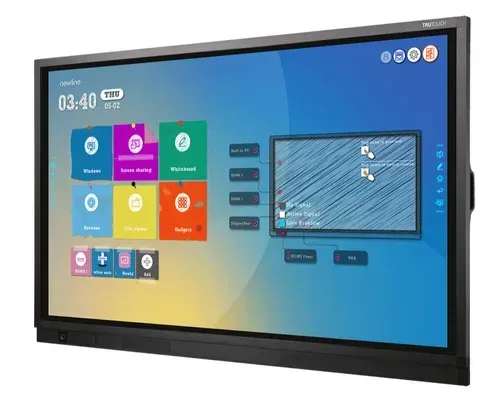
Digital Board vs Projector for Classrooms: 2026 Guide
A digital board costs more than a projector upfront. That's the honest answer. But for most Indian school classrooms in 2026, the projector is the more expensive choice over five years — and the inferior teaching tool every day in between. This guide compares both options across the factors that matter: price, image quality, interactivity, maintenance, and total cost of ownership, so you can make the right call for your budget and your classrooms.
At a Glance: Digital Board vs Projector
Factor Digital Board (IFP) Projector + Screen Upfront cost ₹90,000 – ₹2,30,000 ₹30,000 – ₹80,000 Image quality in ambient light Excellent (350–400 nits, always bright) Poor to moderate (room darkening needed) Interactivity 10–40 touch points, pen + finger None without costly add-ons Lifespan 7–10 years, no consumables 3–5 years; bulb every 1,500–3,000 hrs Annual maintenance ₹8,000 – ₹20,000 (AMC) ₹15,000 – ₹50,000+ (bulbs + servicing) Content sharing Built-in WiFi, screen mirroring, whiteboard HDMI cable (typically) Setup complexity Wall mount, power, one-time install Ceiling mount, alignment, cable run Best for Regular classrooms, smart classrooms Auditoriums, large halls, presentations
Price: What You Actually Pay
A projector setup for a classroom — projector, ceiling mount, screen, HDMI run — typically runs ₹35,000 to ₹80,000. An interactive flat panel (digital board) for the same classroom runs ₹90,000 to ₹2,30,000 depending on size and brand.
Size-wise for digital boards in 2026:
55–65 inch: ₹90,000 – ₹1,40,000
75 inch: ₹1,10,000 – ₹1,80,000
86 inch: ₹1,60,000 – ₹2,30,000
All prices are indicative and exclusive of GST (18%). For most Indian classrooms with 30–40 students, a 75" or 86" panel is the right size for rear-row visibility. At 86", you're spending ₹1.8–2.3 lakh versus a ₹50,000 projector setup. That difference looks large until you factor in five years of running costs.
5-Year Total Cost of Ownership
This is where the maths changes the decision.
Cost Head Digital Board (75", 5 yrs) Projector Setup (5 yrs) Purchase cost ₹1,50,000 (indicative) ₹55,000 (indicative) Bulb replacements (avg 2 per unit over 5 yrs) ₹0 ₹10,000 – ₹30,000 Annual maintenance (5-yr total) ₹60,000 – ₹1,00,000 ₹75,000 – ₹2,00,000 Hardware replacement risk Low (solid-state display) Moderate (bulb failure, alignment issues) Approximate 5-year total ₹2.1 – 2.5 lakh ₹1.4 – 2.85 lakh
The ranges overlap — which is honest. A school that buys a cheap projector and replaces bulbs rarely can keep costs low. But a school running 10+ classrooms on projectors and replacing bulbs as they burn out typically spends ₹50,000 to ₹1,50,000 per year on lamp replacements alone — before factoring in downtime and the engagement cost of dim, washed-out images.
Image Quality: Why Classroom Lighting Matters
Projectors work by projecting light onto a screen. Any ambient light in the room — a sunny afternoon, a tube light left on — competes with the projected image and washes it out. The standard recommendation for classroom projectors is 4,000 ANSI lumens to be usable in daytime without fully darkening the room. Most budget projectors sold to Indian schools deliver 2,500–3,500 lumens, which means curtains or blinds become a daily classroom management task.
A digital board (interactive flat panel) emits its own light — typically 350–400 nits, consistent and always on. There's no dependency on room lighting. A teacher can use it in a fully lit room at 2 PM and the content is visible from the back row. For schools with large south-facing windows or open corridors, this alone often justifies the switch.
Interactivity: The Real Differentiator
A projector is a display device. Unless your school pairs it with an interactive whiteboard overlay (add ₹20,000–40,000 and calibration overhead), it is a passive screen.
A digital board offers:
Multi-touch: 10–40 simultaneous touch points; pen and finger support
Built-in whiteboard software: no separate licence required on most panels
Screen mirroring: teachers and students can beam content from phones or tablets wirelessly
Android/OPS integration: run apps, YouTube, Google Classroom without a connected laptop
Save and share sessions: whiteboard content can be saved and sent to students as a PDF
The pedagogy difference is real. A projector classroom typically has one teacher presenting at the front. A digital board classroom can have students come up to annotate, two students solving a problem simultaneously, and a teacher walking the room while controlling content from a tablet.
Maintenance: The Honest Picture
Projector bulbs fail. The average lamp lasts 1,500 to 3,000 hours — roughly 2–3 academic years of daily classroom use. Replacement bulbs cost ₹5,000 to ₹15,000 per unit. Multiply that across 20 classrooms and you have a recurring procurement burden every few years, plus unplanned outages when a bulb blows mid-lesson.
Digital boards have no consumable components. The LED backlight is rated for 30,000–50,000 hours — well beyond the product's practical lifespan. AMC from reputable vendors runs ₹8,000–20,000 per unit per year, covering service visits and part replacement.
When a Projector Still Makes Sense
There are legitimate use cases where a projector wins:
Auditoriums and large halls: Projecting onto a 10–15 ft screen for 200+ students is impractical with even the largest IFP. A projector or laser display is the correct tool here.
Very tight capital budgets: If a school cannot stretch to ₹1 lakh per classroom, a projector delivers presentations and video content even without interactivity.
Temporary or flexible spaces: Where walls cannot be drilled, or where the classroom arrangement changes frequently, a projector on a cart is more flexible.
For standard K–12 classrooms where the board is the primary teaching surface used daily, digital boards win on every meaningful metric except initial sticker price.
What About Smart Boards vs Digital Boards?
In India, "digital board," "smart board," and "interactive flat panel (IFP)" are often used interchangeably. Technically, "smart board" often refers to older touch-enabled projection-based boards (originally a brand name), while a digital board or IFP is a self-contained flat-panel display with built-in touch and compute. For schools buying in 2026, IFPs are the standard recommendation — projection-based interactive boards are older technology with more failure points.
For a deeper look at how digital boards transform classroom delivery, see our guide: All About Smart Classrooms. And for those considering a move to 21st-century learning models, digital displays are the baseline infrastructure.
Frequently Asked Questions
Is a digital board better than a projector for teaching?
For most classrooms: yes. Digital boards offer better image quality in all lighting conditions, touch interactivity, built-in software, and lower maintenance costs over time. Projectors have a lower upfront cost but are more expensive to run and offer no interactivity without additional hardware.
What is the price of a digital board in India in 2026?
Interactive flat panels (digital boards) for classrooms range from ₹90,000 to ₹2,30,000 depending on size (55"–86") and brand. Most school purchases are in the ₹1.4–1.8 lakh range for a 75" or 86" panel. Prices are indicative and exclusive of GST (18%).
How long does a digital board last?
A quality IFP has an LED backlight rated for 30,000–50,000 hours and a practical product life of 7–10 years. In comparison, a projector's optical components degrade faster, and the lamp requires replacement every 2–3 years of classroom use.
Can a projector be made interactive?
Yes, with an interactive whiteboard overlay or an ultra-short-throw interactive projector — but these add ₹20,000–50,000 to the setup cost, require regular calibration, and introduce more failure points. In most cases it's cheaper to buy an IFP than to retrofit a projector for true interactivity.
Which is better for a coaching class — digital board or projector?
Digital board. Coaching centres typically run back-to-back batches in rooms that can't be darkened. An IFP provides consistent brightness and eliminates the setup and teardown overhead between batches.
The Bottom Line
If you're equipping classrooms for 2026 and beyond, the digital board is the better investment for daily teaching. The projector's low upfront price is real — but so are the consumable costs, the image quality compromise in lit rooms, and the absence of interactivity. A classroom fitted with a quality IFP will serve students and teachers better for a decade with minimal maintenance overhead.
AVM Infotech supplies and installs interactive flat panels for schools, colleges, and coaching institutions across India. For a site visit, product demonstration, or a customised quote for your campus, contact our team or call us to discuss your requirements.

