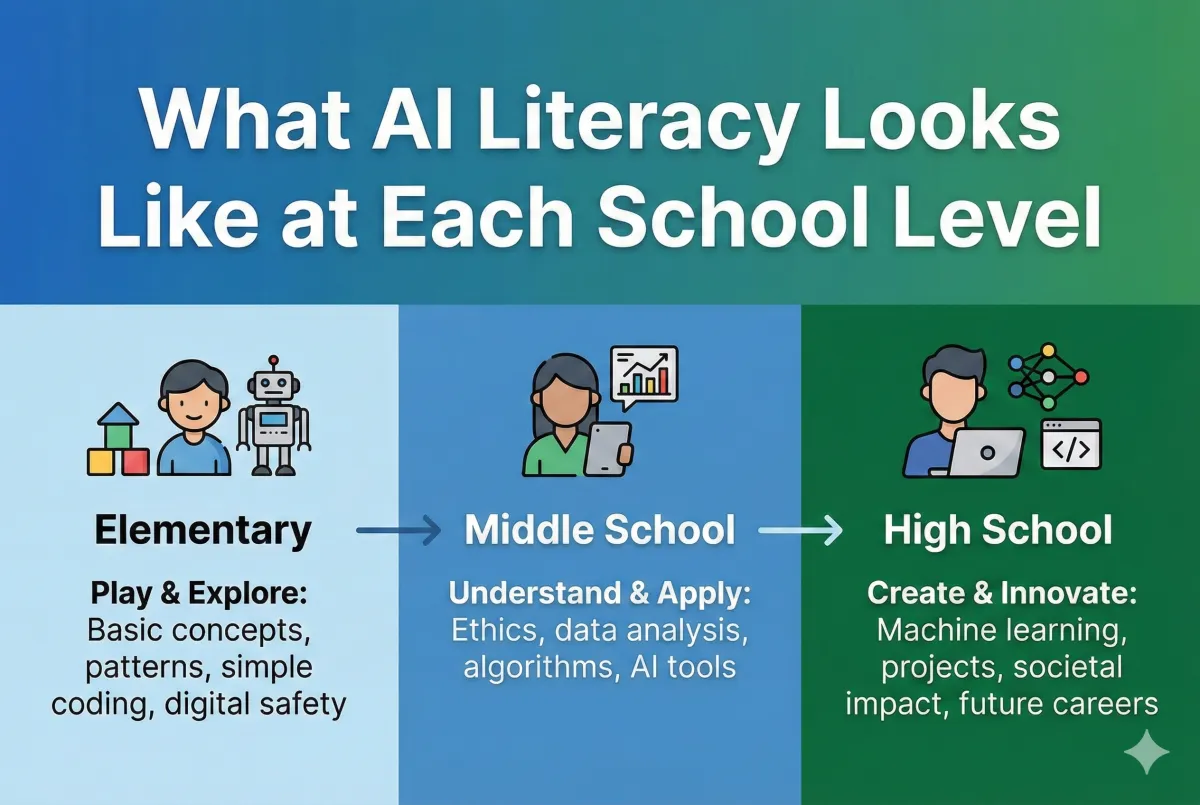
What AI Literacy Looks Like at Each School Level
In a world rapidly shaped by artificial intelligence, schools play a crucial role in helping students develop AI literacy, a foundational skill that goes beyond coding or building models. At AVM Infotech India Pvt. Ltd., we believe AI education should evolve with a child’s cognitive development, teaching them to think with and about AI in age-appropriate ways.
AI literacy changes as students grow. It begins with curiosity, matures into analytical thinking, and culminates in ethical understanding. Here’s how it looks across different school levels.
Primary School: Observation and Cause–Effect Thinking
At the foundational stage, young learners are naturally curious about how things work. AI literacy here isn’t about programming, it’s about observation and reasoning. Teachers can introduce simple, playful examples: “How does a voice assistant understand you?” or “Why did the robot move when you pressed that button?”
By connecting experiences to outcomes, children develop a sense of cause and effect, understanding that machines “learn” through patterns in data. Activities like sorting objects, exploring digital games, or noticing how search results change help them build early logic and pattern-recognition skills, key building blocks of future AI understanding.
Middle School: Logic, Bias, and Patterns
As critical thinking skills develop, students begin to notice that technology can make mistakes, just like humans. This stage focuses on logic, bias, and pattern recognition. Learners can explore how recommendations work on streaming platforms or why image recognition sometimes mislabels things.
Teachers should emphasize that AI systems reflect human choices and data, meaning they can inherit biases. Class discussions around fairness, accuracy, and representation teach students to approach AI outputs thoughtfully. The goal isn’t to master the tools but to understand how they think.
Secondary School: Ethics, Systems, and Evaluation
By secondary school, students are ready for deeper discussions about AI’s social and ethical implications. This stage focuses on evaluating systems, asking how AI decisions affect jobs, privacy, or democracy. Learners examine AI-driven scenarios, evaluate algorithms’ consequences, and explore questions of accountability and transparency.
Students might simulate AI decision-making in projects, compare human and machine judgments, or debate ethical dilemmas. This prepares them not just as users but as responsible citizens in an AI-driven world.
Skills Over Tools: The Core of AI Literacy
True AI literacy lies in developing skills over tools. It’s not about teaching every student to become a data scientist; it’s about nurturing curiosity, logic, and ethical reasoning that scales with their age and cognition.
At AVM Infotech India Pvt. Ltd., we empower schools to embed age-appropriate AI learning into their curriculum through innovative educational technology and teacher training. Because AI literacy is not advanced tooling, it’s age-appropriate thinking that prepares every learner for the future.

